Exploring the world of fiber, one draft at a time

My posting can be as frequent or infrequent as my spinning, so be as patient as that fiber, sitting in my stash.

Thursday, July 08, 2004

Pounds O' Yarn

Anyone care to guess how many yards are in 45 pounds of yarn?

I find it interesting that sometimes just the information I need appears in a magazine or book right before I need it. I recently purchased 24 back issues of knitting machine magazines. Lots of the patterns are not available to me on my very basic knitter, but the articles have been informative. One article I found last week explained just how to determine how many yards of yarn are on a cone, based on thread count and weight.

But let me back up. I needed this information because I went on a road trip to Adairsville, Ga to R&M Yarns. I found this yarn outlet several years ago when driving to Ga. I made my hubby stop and I found out that the yarns were all on cones, and were mostly usable for weaving projects (and I am not a weaver). So I filed that information away in my head, and would get a card in the mail from them every year announcing the $1.00 per pound annual sale. It sounded tempting, but I was never going their way at the right time to go.

But this year, the website announced, would be the last year for the sale and the price would be $1.50/lb. That's still a good deal, since the yarns average $2.50 to $5.00 per pound normally. So I twisted hubby's arm, roped my daughter into going along, and we heading to Ga for the sale last Sat.

We had to spend the night in a motel Friday night. I admit to a sense of anxiety that it would be a bust, that we had driven 350 miles for nothing. We went there bright and early Sat morning and the first thing we see is a husband carrying out yarn by the black trash bag full. I snicker, I wouldn't be buying _that_ much, and go into shop.

This is a true warehouse. Shelves and large metal carts of yarn on cones all in neat orderly rows for your shopping pleasure. It took over an hour to inspect every yarn, make some selections, re-evaluate the choices and check out. I then realized why the black trash bags. They had a large platform scale, and the cones of yarn were thrown into the trash bags to be bulk weighed. Each bag would hold 16-18 lb of yarn. So I ended up with three bags, and my daughter with one. Fortunately even if someone had laughed at my buying trash bags full of yarn I would not have cared by then. I was on a major bargain high.


Here's the picture my friends have been waiting for. If you are a yarn store owner, or have a major aversion to acrylic fibers, avert your eyes.

Pounds O' Yarn Posted by Hello


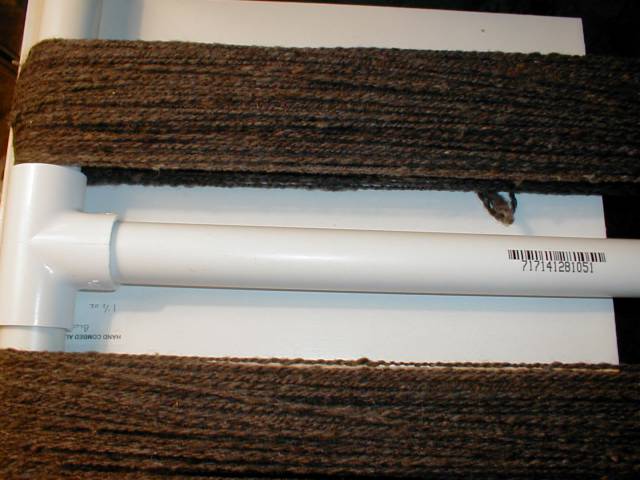
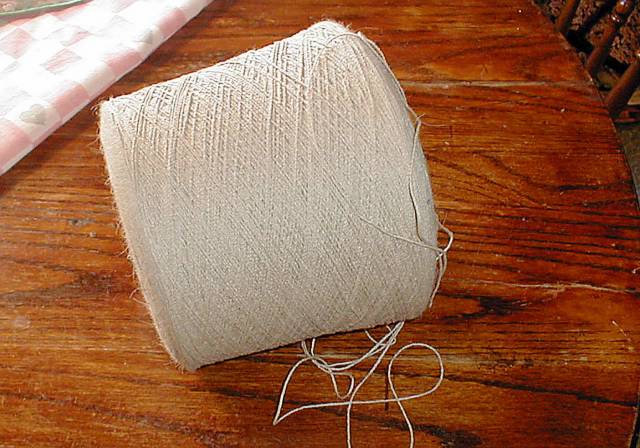
There is probably no way for you to see the yarns specifically. So in a short recap there is a wonderfully soft, fingering weight acrylic in cranberry, marine, brown and grey tweed. That accounts for six of the big cones. The four colonial blue cones of yarn is a 2 ply sport weight 100% wool. The two cones of green (thyme) is a 4/2 cotton in sport weight. The large brown and white stripe yarn is a 2 ply cotton blend, over 5 lbs of it in a sport weight size. The three red cones (I wanted a Christmas color) turns out to be thread sized yarn, a wool/nylon blend. One cone is a rayon silver with black dots, I just had to buy that and see how it would look as a knitted fabric on my knitting machine. And one cone is a mystery Trevira. I googled that and found the website for the fiber, it's mainly a blending fiber with the claim of non flammability. They blend it with cotton or wool. This white cone seems to be cotton like, but there is no indication of any fiber other than the Trevira. And finally there are two balls of chenille, that just look like they are made for each other.

And since this was already on my knitting machine, and I forgot to include it, the last cone of the 45 lb is a fawn colored 100% camel. Yeah baby, _that_ was a real steal.

Camel yarn Posted by Hello

So back to my original question, just how many yards do I have? Based on information from the Sept/Oct 1994 Machine Knitter's Source this is how I tried to calculate.

=quote=

The worsted count system is based on a #1 thread which yields 560 yards per pound. (The #1 thread is comparable in size to a bulky weight or doubled stranded 4 ply knitting worsted in the U.S.) All yarn sizes- 3/15, 2/24 3/12 4/8 etc-are a ratio fraction of the #1 thread size. The upper number of the fraction tells us how many plies are twisted together and the lower number refers to the thread size. Reduce the fractions to compare them to the whole. For example, a 3/15 yarn-3 plies and of #15 thread-is reduced to 1/5th the size of #1. It would take 5 of these threads plied together to equal the #1 thread. To arrive at yards per pound, multiply 560 yards by the number of reduced thread to equal the #1 thread size. In the case of the #15 thread (a single thread), 560 x 15 = 8400 yards per pound. When more than one thread is plied, reduce the yardage by dividing the new yardage by the number of plies used. In the same example, using 3 strand of #15 thread plied together equals 2800 yards per pound (560 x 15 = 8400 divided by 3 = 2800)

=end quote=

They made it sound somewhat complicated, because you can arrive at the same number by taking 3/15 and reducing to 1/5 and multiplying 560 x 5.

Once you have the YPP (yard per pound) you can weigh the cone, and come up with how many yards of yarn are on the cone. Of course there is weight to the cones themselves, and unfortunately that is not a standardized weight, so I tend to round down at the half way point. If the cone weighed 1.25 lbs I used 1 pound to calculate. If it weighed 1.75 lbs I used 1.5. It was all an estimate in the end, due to not knowing the weight of the cone itself.

One other bit of information gleaned from that article. The magic number of 560 is really only for wools. For cottons the magic number is 840. For linens, the number is 300. If the fiber is a blend it was suggested to use the number for the highest content in the blend.

So if the thread counts were listed on the cone, I could easily calculate how many yards I had. But it turned out the only ones that easy were the chenilles. They very conveniently put the YPP on the cone :) 1300 YPP and one cone at 2.5 lbs and the other at almost 3 lb gave me around 6500 yards of chenille. It got harder after that. The thyme cotton for example was listed as a 4/2. I could see that it had 2 plies, so I took the magic number for cotton 840 and multiplied it by the reduced fraction of 2 giving me 1680 YPP. A cone averaged 2.5 lbs for 4200 yards on each cone. Well, it is a guess, but probably an intelligent one.

Not many of the cones had the thread count listed, so for the wools and camel I turned to Amos Aldens grist measurement chart based on WPI. After all, these wool yarns looks just like what I would spin on a good day. The colonial blue was 22 WPI and in the chart that averages 480 YPP. Given that information each small cone had about 500 yards and the large on around 2000 yards. The camel had a 30 WPI and the chart says that is 904 YPP, so I have around 1800 yards of camel yarn. And the red wool nylon thread, well now, that did have a thread count. An amazing 2/45 thread count. Thank goodness I did not have to try and do a WPI on that. Using the calculation of 24.5 x an average of 3 lbs total for all three cones, I get a yardage of somewhere Beyond 39,000 yards. Obviously I was not paying attention to that purchase, beyond the red color!

All of these helpful calculations are not helpful when I comes to the acrylic. I am unfortunately back to the old fashion, knit until I run out of yarn tactics with them.

Grand total yardage? Ah come on, did you really think I would know that? But yes, I did come up with a number, just for the fun of it. I used the 560 magic number for the acrylic, right or wrong, I don't know. But using that and adding everything up, the total comes to 116,200 yards.

You think I have enough for a sweater? BRHAWWAAAHAAAA!

CW


Thursday, July 01, 2004

AHA Moment and Why I Spin

There is a wealth of information available about spinning now. It amazes me that this gathering of information has happened over the last 30 years, and that the internet has been the biggest factor in the growth of this accumulation. The ability to discuss and debate techniques or to share what is learned has boomed even more in the last five years with the arrival of online groups and blogs.

One such source of learning for me has been a Yahoo group called Tech spin. This group has very interesting and knowledgeable discussions on many aspects of spinning.

Recently I was thinking about how to spin a Black Welsh Mountain fleece I have washed. I envisioned a fat fluffy yarn, which I would knit to felt into a bag. There are several immediately concerns about that project, so I asked my questions to Tech spin. First, how to get a fluffy yarn. I thought and even tried spinning long draw from a drum carded fiber. I was not having any luck, I could not draft the fiber that way. Was it because I just can not do long draw? Was it that the fibers were too long? Was my prep not right for long draw? These are questions I asked the group. The second concern was of my own. I was not sure I really wanted fat fluffy yarns to try and felt. But that I knew I would have to swatch to find out.

The group responded with several ideas about long draw. Then Elaine posted a great explanation that, if I really wanted lighter fluffy yarn, I needed 3 or 4 plies, not two.

I will not quote Elaine here, instead try and write what I learned from her post. If a 2 ply yarn needs a certain number of twists per inch (say 12) each single will need 6 twists per inch. But suppose I made the yarn a 3 ply, then each single would only need 4 twists per inch. And less twists per inch means the yarn can have more open space, for more loft, which means a fluffier yarn.

This was a real AHA moment for me and a few others that post to that group. Elaine also suggested that this concept is useful when working with the coarse longwools. The longwools when tightly spun tend to resist the twist, making the wool harsh and dense. Lessen the number of twists per inch and increasing the plies can make a more pliant yarn. Not necessarily softer, but more workable.

She gave us a rainy day project of trying this with two different yarns in our stash, like a merino and a longwool. Spin each the four possible ways, thin and very little twist, thick and very little twist, thin and lots of twist and thick and lots of twist. Make samples of 2, 3 and 4 plies. Set the yarn and then knit a swatch.

Oh course this is just the type of project I love. This was my second AHA moment about just why spinning has become an addictive hobby for me. It's not at all just about making yarn to knit a sweater. It's the fact that from raw fleece to finished sweater, there are about a million possibilities. And each difference is not really a failure, it usually becomes a design element.

So now I understand why I have many unfinished projects. Once I get past the learning of how to wash a particular fleece to give it it's best attributes, I stop washing the fleece. And once I have messed around with the different processing ideas for that fleece (drum card, hand card, dog combed locks, small hand combs, big hand combs) and found the processing that gives the best spinning fiber, I stop processing. I seem to have stopped here though in this trend. Once I sit down to spin a yarn, I pretty much have always spun the same type of yarn, a consistent 15-18 WPI 2 ply. The only time I have actually just played with spinning is when I was working through different fibers for the rare breed study. Or if I am involved in an exchange, where I try a fiber or technique (like spinning froghair-spinning as fine as I could).

Now that Elaine has just invaded my spinning with challenges I will never get a full skein of yarn spun again. I think I am really excited about that!

I am not sure having discovered just why spinning is so addictive for me will make it any easier to explain to non spinning folks. But it helps explain to myself the appeal of yet another raw fleece, when I already have a fleece mountain in the spare bedroom. I am not just buying greasy wool, but the possibility of hours of learning and fun.

CW

Sunday, June 13, 2004

Spinning laceweight in the grease

I was working on my next to the last batch of the Rambo fleece this morning, picking it before putting it in the cold water soak. And I am finally working on the very best of the fleece. There is one batch left, and as I was picking and sorting, my fingers got very itchy to try and spin some of it. It is very soft and fine, and normally I would try and take some of this prime area and wash the locks to spin a lace weight yarn. I still think it would not be worth the time and effort to lock wash, because the locks have very little intregrity. Also for all of it's softness, I know Rambo is a cross with a merino, and I know merino will poof into yarn much larger than what it first looks like. Still, it was so tempting, I decided to just do some sampling with the locks in the grease.

It worked good, because today is very warm. The locks were not at all sticky.

I used my mini Bosworth spindle which weighs .77 oz. It was a good choice, since it has enough weight to keep spinning, but not enough to pull my fiber out of my hand, and drop.

First sampling was to just take some locks, pull out any VM or tips, elongate the lock some (like predrafting) and spin. I started with the butt end and worked to the tip. There was usually a bit of fluff that I did not include when I finished the lock. My drafting triagle was by no means fine enough to count the individual fibers, but it did let light through :) I spun some singles, checked the WPI and then did a 2 ply. The resulting samples are on the lower part of the card in the picture below.

The second sampling was to take the locks and comb them with a dog comb, doing both ends out, and trying to open the middle of the lock also with the comb. This is still in the grease. I was surprised to find I did not see much difference, in the two yarns. This combed 2 ply could be said to be just a bit smoother, but it was not as thin as the above 2 ply. And I had more trouble spinning the locks after they were combed, which also surprised me.

Sample card of Rambo lace in the grease Posted by Hello


If you look closely, you can see how much the halo the yarns have, even wrapped tight on the card. Along with this, I know the yarn has had alot of bounce in the skeins I have spun so far. None of this has made a decision for me yet for the processing of the final part of this fleece. I think I will be practical, and do it like the rest, and leave the lace spinning for some fleece still hiding in my stash. It's tempting though, because it is a lovely brown color, that would make a great lace scarf.

CW


Friday, June 11, 2004

Working with Rambouilette

I have been working every morning on washing fleece. I seem to have developed a pattern, where I pick enough fleece to fill two 5 gallon buckets. I fill the buckets with cold soapy water, and put the fleece in it and let that soak until the next day. Then what had soaked the day before gets washed in my kitchen sink. One hot water wash with liquid laundry detergent, and a second even hotter (I add boiling water) wash with Dawn. Then a very hot rinse (with boiling water added) and a regular hot water rinse. I put the fleece in a mesh bag, give it a short spin in the washer spin cycle, and put it out to dry. It is dry by the next day. I take what is now dry and drum card it, and in the evening after work, I spin what I have drum carded.

It makes me feel like I am really making progress, although in truth I am not. I get that feeling I think because I am more focus on one thing, getting this fleece washed.

I have been working on a Rambo fleece that I bought sight unseen. It is a lovely deep brown color, but it does have some problems, and therefore was very inexpensive. I have found that I can eliminate almost all of the 'problems' in my processing, except for the weak tips or a break in the lock. This fleece is sound but it does have weak tips.It is just not feasable for me to cut them all off. The sheep was not coated and so the tips are very sunburned. So I have just been pulling them off whenever I can, and know that I will not sell the yarn, but use it for myself.

The fleece is worth processing time to me, because of the softness. After it is washed and carded, and even the yarn, is the softest wool I have ever spun.

When I first open a fleece, I will seperate it out into several piles. One obvious pile is for mulch, depending on how well the original skirting was done, this could be a little or alot. I probably lost about a pound of this 6 lb fleece to mulch. Then I try and pull out the worse of what is left. In this case it was areas around the rump that has nice wool but is pretty dirty, and also under the neck, which had lots of hay in it. The third thing I pull out if I can determine it, is the area across the shoulders of the sheep. This is traditionally the area of the finest wool, and is often used for lock spinning very fine yarn. There was not good lock definition to this fleece, but I pulled that area out to process as a batch. And finally the rest is the prime blanket area over the back, that gets processed as a batch.

I almost always process that extra dirty batch first. I do this for a number of reasons. One, if the way I think the wool should be washed does not clean the very dirtiest, it will not clean the best part. So I am using the worse part for experimentation. The cold water soak was an experiment with this fleece (one that turned out to be a very good idea) Second, when I start handling a new fleece, I am all excited about it, and will take the extra time and effort that those dirty bits need. By the time I get to that last batch, the prime blanket, I am tired of the fleece, but fortunately that area needs very little extra effort.

I mentioned that I find I can process out most of the faults in a fleece. The first thing I do is to take some fleece between my two hands and really shake it. I had always heard people say to shake a fleece, but found shaking a whole fleece is not what they meant. If I take a length of fleece between my two hands and really shake it, the second cuts go flying, and so does a lot of the VM. So I do this before I pick the fleece apart.

I pick with my hands. I would like to have a picker, but it bothers me to use a picker for both unwashed and washed fleece. If I had one, I would only use it on clean fleece. I have had an opportunity to use one, and I am undecided about whether I want one or not. I just did not get the hang of making the one work that I was trying. So I sit on my porch and pick a small batch at a time, and it saves my hands from getting sore. This is where most of the VM falls out.

There is a very frugal streak in me. Could be my German heritage, could just be my Taurus nature. I hate to throw anything away. So I was curious just how much 'yarn' I would get for my extra effort on the two dirty batches, and kept good records. I processed it just as I mentioned above and ended up with this from my drumcarder.

Looks like a lot but is only 5.5 oz Posted by Hello


I was very pleased to discover that my Patrick Green drum carder, with the fur drum, likes this Rambo fleece very well. I have tried to card merino on this fur drum, and ended up with neps. Not so with this fleece, with is why I became even more encouraged to continue the processing inspite of the tips. By the time the fleece had two passes through the carder, I had very wonderful batts that spun into this:

190 yards of very soft yarn Posted by Hello


It is a very deep brown. The carded batts look gray in the photo and gray/brown in real life, but the yarn ended up being a lovely deep tweedy brown. It is 13 WPI 2 ply, a bit too thick for socks (I wouldn't with the possibility of neps anyway) but I know I am going to use it for a shawl for me possibly with some dyed yarns.

Is it too much work? Probably. Right now it is a nice stress relieving project in my mornings before I go to work.

CW

Finally pictures on the blog

Thank you to Annie for discovering Bloggers new picture linking software by Hello. If you are not using it and have a blogger account, check it out. It is very simple to use. The only thing I found is I am use to using Adobe on my computer to make the photos better, and can still do that. I was hoping to avoid that step, and the pictures in the posts are straight from my digital camera, to my computer and then to the blog through Hello by Picasa.

I also found out that it thinks each picture is a blog entry (unless I have not figured out how to use it properly) So I had to fiddle some, to get both pictures on one blog entry.

Still...pictures at last without messing about with Yahoo.

CW


Saturday, May 29, 2004

Second baby blanket pictures

It is finally finished!

I have found that knitting with a deadline this time of the year is very hard. My free time is taken up with outside work, and I am too sleepy from the fresh air in the evenings to stay up and knit. Especially a project that is just knit stitches, I found myself falling asleep over my needles a couple of times.

Hereis the picture.

The pattern comes from the book Quick Knitted Afghans (HA!) published by House of White Birches. I really like many of the patterns in this book. This one called Warm and Cuddly Baby Afghan was designed by Uyvonne Bigham. It is a very simple pattern to knit once the four basic rows are memorized and a good one to pick up and put down, it is easy to see where you are in the pattern. So it is a good travel pattern.

Hereis a close up of the stitch pattern. Many people have commented that it looks like tiny fluer de leis.

The afghan is worked with two yarns, but unlike most colorwork, the yarn is not carried across the rows. Instead, you knit two rows with one color, slipping the stitch of the opposite color to give the illusion of multicolor work.

The side bands are not knitted until after the body of the afghan is complete. So eleven stitches are put on holders on either side of the afghan. When the body is complete, then the eleven stitches are knitted up to fit the side of the afghan. The pattern says to knit the whole band and sew it on, I chose to knit on short double pointed needles and when I was next to the afghan, I picked up the end stitch of the afghan, and combined it with one of the border stitches, either knitting two together, or passing the stitch over the extra one, depending which side of the afghan I was doing. The only thing I had to watch was that I was making a smooth seam up the edge, since the garter stitch with just one color could have a different gauge than the colorwork. I found mine was matching pretty much up row for row.

I already know the mother to be loves the pattern, this is the afghan I have to wrap up partially finished for the shower :) She still has another month to go before baby's due date, so I made my goal of getting it to her before the baby was born.

CW

Thursday, May 20, 2004

The library

Since my daughter recently learned how to knit, she has been bitten by the knitting book bug. But unlike me, she is very close to our big downtown library, and has been using that as a source of books. She said to me the other day that the library really had a great collection of knitting books, and that I should check it out. So Tues, on my way to work I did stop by to do just that.

As I walked down the 700 aisle (arts and crafts section) looking for the knitting books (textile history, embroidery, tatting, it was hard to make any progress down those shelves!) I hit on a section on spinning! And was amazed to see that they had 18 books on the shelf on spinning. I settled on two of them to check out.

The first was a charming little book called The Magic of Spinning. It is written by Marion L Channing, with a first copyright of 1966. It was published by Channing publishing! And the illustrations are done by her husband. But wait, it's even better, the book is signed by the author herself. What a gem. It is a tiny 48 page very basic book on spinning. There's not a website listed in the references :) She thanks Paula Simmons for her help with the book. It was a treat to read. And it was put in our library, by the stamp on the front of the book in 1984. How amazing.

From that tiny beginning, we now have the second book I checked out, Alden Amos Big Book of Handspinning. It is a whopping 500 pages, and was copyrighted in 2001. It just amazes me the information, skills, and experiences that are now available about this subject. Yes it has been almost 40 years. But with the advent of the internet, the new wave of 20 something knitters, think of how much more information will be tested and gathered in half that time in the future.

I did finally make it to the shelves with the knitting books. There is an amazing three shelves full. I really commend my library management for this. I have a book shelf full of knitting books myself, however there were many there I have not had the chance to see, let alone buy. I checked out, Slip-Stitch Knitting by Roxana Bartlett and Knitting Around the World, published by Threads. I also found two machine knitting books, The Machine Knitter's Handbook and The Machine Knitter's Design book, both by Hazel Pope.

So the library cycle has started again. When I go back to return these books, I of course wander over and look at the stacks again. For many months I have avoided the library, just because of this cycle. I have bookcases full of books here. I feel I need to read some of these, and either keep them or move them on. But that is not how it works. If the book or magazine is my own, it can lanquish on the shelf, I won't make it a priority to read it. However, a library book, with it's overdue deadline, makes me find the time to read it. That's either a good or bad thing, depending if I have the time or not:)

Ah reading. It is one of my daily pleasures, whether I read a book, an email, a blog, a magazine....

Cup of tea and a good read anyone?

CW

Saturday, May 15, 2004

A Bunny Update

I don't blog about my bunnies much anymore, but they are still very much a part of my daily life, and especially part of the time I spend on fiber related projects. And the last two months I have been spending more time on the bunnies, now that the weather is warmer. So I thought an update would be good.

I did not breed any rabbits this spring, so everyone in my barn are now adults of various ages. The ages range from a little over one year (born early last year) to one old man of nine. I currently have 18 bunnies. Each have their own cages, and the cages are in lines of four or six, so most have 'neighbors' They seem to like having neighbors, but like good neighbors, also like those good 'fences' (that is cage dividers) Two bunnies in the same cage (unless babies growing up together) usually mean a tussle, either for space or for the decision of who is on top (grin). But they like having the company of that bunny next door, and I try and keep the bunnies in cages in a row. That makes the feeding and watering easier too.

So since my barn has around 30 cages and since I am down to 18 rabbits, one of the ongoing projects the last two months has been to repair and clean cages and then move bunnies to a more consolidated group. The work is progressing, but very slowly. I work full time, so it means first I need a day off, and second, a day I am not just absolutely worn out from working, and third, reasonably nice weather. Once I get all three factors, it ends up I have about one day every other week to spend 4-5 hours working in the barn. But it progresses, and will eventually be done.

The other 'chore' of course is grooming rabbits. Many are to the point of needing plucked right now so I spent one day last week, grooming six rabbits. (As an aside to those that are not familiar with angora rabbits, they grow a coat, and then molt it about an average of three times a year. When the coat is molting, it is possible to just pull the fiber right off of the rabbit. This is one way that angora is harvested, the rabbits can also be sheared when the coat is to the right length. Plucking does not hurt the rabbit, if the coat is shedding. If the fiber comes out in my hand that means it is loose. If I did not harvest it, the rabbit could ingest the fiber while grooming itself, and cause it's death by woolblock.)

Here
is a picture of one of my french does in full coat. Her name is Reboot, because my daughter found her out of the nest and chilled, warmed the rabbit up and it lived. So we call it Reboot.

Reboot has a wonderful coat. The color is called a blue, and the fiber averages six inches in length. The is some guard hair, which will be spikey when spun, but is not itchy. It is very very soft. I do spin most of my angora as 100% yarns, and use those yarns as accent brims on hats, or to knit a very warm scarf.

I raise two different breeds of angora, french and satin. Here is a picture of a satin buck in full coat. His color is chestnut with rufus (which means there are reds in the coloration)

Satins are known for their very intense colors and shine to the fiber. This happens because the hair follicle has a clear tip, which reflects the light and gives the shine. The intense color happens because the fiber length is on the average, shorter than the other angora breeds. When any angora rabbits fur grows, the color gets diluted the longer the fur grows. The tip is the most intense color (and can be a different color that the main part of the fiber) As the fur grows, the color changes to a base color, generally white or gray or tan. Genetics determine all this, and what color the rabbit is called is based on those genetics.

Since satins tend to have fiber lengths of around 3 inches, there is less amount of the base white or gray to dilute the color and it looks more intense.

This rabbit does not really have a name. Most of the rabbits in my barn are referred to mainly by their breed, color and sex. So he is my chestnut satin buck. I don't have any others like that so it can be a unique name for him. I did have identical ermine satin bucks in one litter, I guess rabbits could have twins. They are so identical, I had to name them. Ummm A and B. I never was very creative with rabbit names. It might be that the fun of naming them wore off after about five years of trying to think up names for that litter of eight. I have used the names of Santa's reindeers (I still have Vixen) and off course all of the common rabbit names (in fact I have two Jack's right now, one I had named, and one came with that name) One time I had to take a rabbit to the vet. Since this was a small animal practice, the receptionists ask immediately 'what is the animals name?' After a pause I said, I call her Lilac (that's the color of the rabbit). 'Funny name for a rabbit' was the reply :)

But named or not, these rabbits are very much a part of my daily routine. I spend much more time with them than the fiber would ever repay. It just makes me smile, when I go to one of the bucks cages to give them food, and they demand a head scratch instead.

CW

Friday, May 14, 2004

Oh Brother, what have I started?

Actually it all started when a knitting/spinning buddy went to an estate sale, and an old Brother knitting machine came with an odd lot that she bought. She casually asked if any of us were interested in a knitting machine, warning us that she had no clue if it would work or not. I said, sure why not and took it.

That was last Dec. I knew nothing about knitting machines, so I went to the standard source of information, Ebay (laughter). After looking at many pictures, I did come to the conclusion that what came home with me was missing many pieces. But the bug had bitten me, and as I searched Ebay, I was starting to pay attention to prices.

I finally found one that I thought was an amazing good deal. Probably what hit me first was that it at least had a case of very similiar color to the one I already had. And there were pictures of many more parts with the one on Ebay. So I bid and won, and ended up buying a Brother KH 601 knitting machine, from of all places, the Tacoma Goodwill!

It arrived mid Feb, and I found a place about 2 hours from me that still serviced Brother machines. I took it up there March 9th (I know the date for sure, it was my hubby's birthday). Tues this week I got the call that it was ready to be picked up. Since I was off from work on Weds, I drove the two hour trip again to pick it up.

The owner of the shop was fantastic and gave me a three hour lesson on it. Along about the 2 1/2 hour mark, I think my brain exploded :) But I had a nice sample swatch knitted, and along with the manual and the yahoogroups that I had by now joined, I can say I now can knit on it.

I have been ebay shopping for some pattern books and general machine knitting books. I bought a couple years worth of Machine Knitters Source magazines. They are from the early 90's but I still think it will help me learn. I am doing what I always do, when learning a new skill, read, read, and more reading. Right now, in many ways it is like trying to read a foriegn language I just barely understand. But if I become too frustrated, I can go and just knit on it as there are lots of things that can just be created from straight knitted squares. Right now I am just walking through each page of the manual and making sure I understand the basics.

Fusion Knitting has a blog that I read all the time. She is very machine knitting oriented and a constant source of information and inspiration. Her recent post, making a tank top in just two hours has me sure that I have made a great investment by buying this machine. Not just investment moneywise, but time.

Oh, and a final serendipity of it all. These Brother machines have not been manufactured for awhile. Parts for them, including the precious needles are hard to find. So even though the freebie machine handed to me by my friend had no real parts to it, what it did have was 200 needles, and they are an exact match for this new machine of mine. That is like finding a treasure chest of gold. The old freebie also included a stand, and that is another wonderful thing. It sets the machine up to a comfortable, sit on a chair level. I grin everytime I walk past the set up now. Thank you knitting goddess, you have set me on a new path.

CW

Thursday, May 13, 2004

Blogger's new look

If you haven't been to blogger.com and that is what you are using for your blog, you need to go and check out all the new templates. Cool stuff. I think I will stick with my green for now though. I've gotten fond of it.

So this is a test to see if the comments addition to the blog is working.

CW

Wednesday, May 05, 2004

A natural gold color

Or at least close enough for me. I am really pleased with how the ragwort dyed my yarn. Here is a picture of the yarn.

So if you want to duplicate this, here's how (and I bet it wouldn't exactly match, that's the fun part of natural dyes)

Take a bucket full of ragwort flower tops (see my previous post if you need a picture of the flower) Put them in a large stainless steel stock pot and bring to a boil. While that is heating wash skein of yarn to be dyed in soap and water, and rinse well. Then place in a mordant bath of alum water (this is a moderate stainless steel stockpot filled with water and two heaping tablespoons of alum and one teas of cream of tarter dissolved in it) Let yarn soak in mordant water while dyepot boils. I boiled the blossoms for about an hour. Be sure there is plenty of ventilation while you do this. The liquid will be a gold brown clear color.

Strain the dye liquid from the flowers and place in old crockpot. Put skein of yarn in the crockpot and set to low. Let simmer overnight (or as I did, while I was at work) I could see that most of the color was out of the liquid. I removed the skein, wrapped it in saran wrap, and microwaved it for 2 minutes. This will set the twist, I do not know if it will help it to be colorfast.

Then I washed the skein in hot soapy dish detergent and a smidgeon of borax.(it really smelled bad, sort of off flavored brussel sprouts type smell) I saw a little of the color rinse off. After that I rinsed the skein in hot water with a glug of vinegar in it (I am doing all this in my kitchen sink) I could see the color brighten some after doing that. There was no color run off at this point. Finally I just rinsed in clear hot water, towel dried the skein and hung it up to complete drying.

I mentioned that really loving this color meant I had to spin up more white skeins, before the flowers faded. A bright internet friend said that the blossoms can be frozen until I am ready to do more dyeing. So that's what will be done, two trash bags full of the blossoms will go into the large freezer. It will make a very fun addition to our annual fall dye day at my house.

CW

Monday, May 03, 2004

Recent spinning

I have been doing what I call zone spinning, which means I just spin the fiber on my electric spinner, while watching TV, and let the yarn be whatever it wants to be. I stop and pick out VM but other than that, I don't fuss with the roving to force it into thick or thin or a specific type of yarn.

I tend to think I spin pretty much the same type of yarn when I do this. My electric gets set at about the same pull in, and speed. And I get a two ply yarn that looks very similiar, but I was surprised to find how unsimiliar the yarns can be, just changing the fiber being used.

What I did was to take two oz balls of roving per bobbin, and then ply that. I did five different fibers, and took some measurements along the way. That's how I found out how different the fibers made the yarn.

Here's a closeup picture of the five different skeins.

The white corriedale on the far right is from this roving I have posted a picture of this before, when I got it back from Woolyknob fiber mill. That skein is 163 yds, 18 WPI. I had a big difference between the WPI of the singles of the two bobbins, one was 25 WPI and the other 32. I must have gotten more into spinning finer as I went along.

Just left of that is the CVM skein. I bought this roving from Little Barn, and as you can see in the picture, CVM is like merino. It is a very puffy, springy yarn after it is spun. The skein is 162 yds, and the 2 ply is a thick 10 WPI.

In the middle is a Border Leicester that I bought two years ago, and had processed by Woolyknob. The singles were closer at 22 WPI and 24 WPI and the 2 ply is 13 WPI. There is only 120 yds in the skein, being a thicker yarn. I did overspin some in this yarn, I am not sure if it was because I was picking out VM (the electric just keeps on spinning, and sometimes I try and cheat and pull the VM out without stopping the spinner). I think the yarn will relax some when I wash it.

Left of that is the llama that I had processed by Woolyknob. It was an interesting roving. There were very obvious white guard hairs in it, which looked like stiff sewing thread. I could pick them out easily, if I stopped, went over the piece of roving I wanted to spin next, and pull them out. Also this roving had the most VM, llamas and alpacas just love to roll or lounge in the hay. It'll make this yarn hard to use for anything next to the skin, the pricklies still can be felt. The singles spun at 25 WPI and 21 WPI and I had alot of trouble with thick areas happening in the yarn. So the 2 ply is a 13 WPI in a 145 yd skein.

I saved my favorite for last, the brown Border leicester on the far left. I bought this fleece at SAFF, and had it processed at Woolyknob. This spun into a very consistent yarn for me, with the singles at 24 WPI and 23 WPI. The 2 ply is 17 WPI, so I have a larger skein, 173 yds. I love the color of this yarn, a true deep natural brown. I will be making a sweater from this roving, I am sure of that.

The whole point to all this was to see how each of the rovings I have recently purchased would spin, if I was spinning them 'in a hurry' If I plan to make any big knitting project that takes over 2000 yards, I need to be spinning in the most productive method. The CVM would not work, it is too easily too bulky. The llama will not work, it is too itchy. The corriedale will be OK, but needs to be dyed, I am not into white sweaters. And the one BL, will be OK, I may think about a barn sweater, or something felted with that, I am concerned that the yarn would just be too bulky for a shaped and cabled sweater. The brown BL is the winner, now I just have to work on making another 12 skeins _just like it_ :)

CW

Thursday, April 29, 2004

Will It be Gold?

I have a whole field full of this which turns out to be Golden Ragwort. I just found this out last Saturday. I was mowing, and everytime I'd go past the field, I'd think, 'I KNOW that's not mustard' After I was done mowing, I got out my weed and herb and garden books, in search of the plant. I could not find any good pictures, I finally had to go online and find the identification.

What it is commonly known as, is squaw weed.

When I was chatting with my coworkers Monday, on a coffee break, I told them about the field full of flowers, and finding out it's ID. I said that is was called squaw weed, but I couldn't figure out why, because that usually meant it was useful in the tribal home remedies. And this was definately not a common medicinal plant. Then one coworker said, 'maybe it was good for dyeing things, that should be right up your alley!'

(Insert picture of me smacking myself on the side of the head).

My coworkers know me better than I do, it seems.

So that was my intention this morning, to gather enough to try one dyebath with it. I will not be able to do that until the weekend, however, since this field is the one that could be plowed 'any day now' by the farmer that rents the land for planting, I wanted to be sure to get some picked.

I found out there could not be an easier plant to wild pick. It stands waist high, and all one has to do is smack the plant to move any insects along off the plant (figured that out after a bee did get in the bucket) and then bend the plant top over the bucket and snip the blossom. I cut a five gallon bucket full of blossoms in about five minutes. And I probably took a 50 foot length of a very large 2 acre field full of these flowers. They are there by the thousands.

I have no idea if the plant will dye yarn a pretty color or not. I have seen it listed in one natural dye list as giving a gold color, but no indication of what mordent was given. I only have alum to use as a mordant, so this will be, all in all, a very limited dye experiment. Still, I am looking forward to trying, and then maybe in a week or two, showing off the yarn to my coworkers.

CW

Friday, April 23, 2004

Goddess and Dragons, oh my

I thought I'd share the birthday presents I just bought for myself.

Dragonspindle

Goddesspindle


An internet friend bj has a website Moonspinners and these are two of her spindle designs.

They are hard to photograph, because they are shiny. The goddess did ok with my camera, the dragon is even more beautiful than the photo shows. I asked bj to do a dragon design for me, and she found the perfect design and combination of colors for me.
Check out her website and see if you find a perfect design too.

These are fitting birthday presents, since my birthday is May 1st. No matter how old I get, I still love having a birthday, because it falls on Beltane. I think it is a perfect day for a birthday, whether I celebrate alone, or with the whole world (Kentucky Derby is on my birthday this year too!) I clean the porch good and officially declare it open for summer sitting. We will make our traditional May wine, and hopefully build a fire in the firepit in front of the porch. It's a tradition for us, just like birthday cake.

These two spindles have made me think about the possibility of magical spinning. I know one pagan that did knit mittens with intent, and of course there is always the orthodox prayer shawls. What would magical spinning be for? Meditation only? Focus for circle energy? Or would I get too distracted by the 'production' process going on, and not really focus? Anyway it is something to think about, and I will definately be using these spindles at home for the pleasure of seeing their beautiful colors swirl as I spin.

CW

Sunday, April 11, 2004

What I learned at Greencastle

No, I didn't take any classes, unless you want to include life lessons.

It was a great weekend, in all ways. The trip up was easy with several just for fun stops on the way. Setting up the booth went like clockwork, as well as taking it down Sat evening. We know the routine well, and only changed a few things about the booth, so there was less of that, 'well, let's try putting the table here instead'. Friday afternoon sales were brisk, much better than last year, and Sat was steady, but not exhaustingly busy. Friday night we gathered with our yearly group of vendors that we know, and had glasses of wine, and notes of the past year until midnight. I was barely able to crawl into bed Friday night, but fortunately it was a good bed, and I slept well.

In short, it was the type of show Ted and I like, and we left Sat evening still speaking to each other

Here though are the lessons I learned over this weekend.

1. As much as I thought I would like to have it, I do not need a great wheel. The vendor next to us had a restored, fully functioning great wheel, built in the 1780's. There was absolutely nothing wrong with it, and the wood glowed from great care. He was asking only $500. When we saw it, Ted and I talked a long time about buying it. He offered three times, saying he was perfectly happy to pay for it. He longed for that wheel as an antique, and I could only see it as a spinning wheel. So I could justify it, by it being fully functional. I just could not OK putting another 'something' into our already overstuffed house. Especially something that big. I said no to each of Ted's offer, but he knew I really wanted it. So I learned I could say no to something I always thought I wanted, and when found at the right price, didn't buy.

2. I found out I didn't need a small, very unique, fully functional antique wheel. This was sitting right along side the great wheel. It had the advantage of being small, and only $300. It was a tiny wheel, but also had on top a lazy kate, and along side a skein winder. A full yarn factory, in a tiny 24 inches. I had to say no to myself, because I knew, as cute as it was, I wouldn't use it. That tiny wheel (and bobbins) would mean many many treadlings for a bobbin full of yarn, and that the bobbin would be full in no time at all. I wonder if it was a child's wheel. It seems just the thing for a child to be spinning right along side the mom. At one point, since we sat directly across from the wheels, Ted caught me just sitting and looking at them, and said he hadn't seem that look of longing on my face since our second date LOL But I also watched both sell, the great wheel within an hour of the price going on it, and the little wheel later in the afternoon.

3. I learned I really really like getting fiber from the processor, all ready to spin. The three large bags of fiber from Woolyknob Fiber Mill is beautiful. I will rave again about what nice work they do. I did hear one contrary comment this weekend, about a high lanolin fleece not coming back up to the buyers expectations, and then she put the caveat on it that they were just getting the mill going and may have been on their learning curve. Still, it is as I have always thought, the fresh merino and cormo fleeces really need to be wash slowly lock by lock and spun that way instead of made into roving. What I sent were two border leicester fleeces and a two hugh llama coats. The llama was a great surprise, I expected a courser roving, but it was as soft or softer than the one border leicester. I will be playing with that alot, first spinning it alone and then combining on my drum carder with some fibers, to find the best use. The two border leicester were sent at the same time to learn if processing a loose curl wool and a tight wool curl came out different. Visually, in the roving I can see no difference and I am excited about that, because I have found I do not like trying to open the tight curls by hand before washing, and it looks like this processor has no problem picking open the curls before washing. The two fleeces are different in softness, but that has to do with quality of the fleece. One fleece was a last of the bunch, $5.00 for the whole fleece deal. The other I paid $4.00 per pound for at SAFF last fall. After I spin some of the two BL, I will see how much difference there is in the yarn too.

4. I learned that even having a car full of ready to spin roving, and probably five raw fleeces at home waiting for me to work with, I could not go to a fleece fair, and not buy a raw fleece. After I set up my booth on Friday, I let Ted tend it, and I walk around for the first look at what is for sale, and what might tempt me for this years spending budget. Of course I look at all the fleeces. It's wonderful to see the colors, see the locks, feel the difference in texture of each. And I know most of these breeders now, so I have to see their new spring clip. I was doing fine almost the whole way until I got the the gal that breeds cormo. I bought a white fleece from her last year, that I am about half way through lock washing and spinning fine yarn. This year, I stopped to say hello, and check out each fleece, telling her about my love and success with her last year's fleece. I started noticing lots of lovely colors, hmm, BL colors, you know those browns that run into greys that run into a tan tip. So I start checking tags, and she not only has BL now, but has cross breed BL with the cormo. Oh oh. A silver fleece. Oh oh. I checked it out closely, yep, lovely cormo fine silky crimp, but BL color. And no tight BL locks. Just wide open cormo locks. I was doomed to dream of that fleece all night (because at first I walked away saying I had no business buying more raw fleece) So around noon on Sat, when the first lull hit, I told Ted I was going to walk around. My intention was to go and prove to myself that the fleece would have already been sold, and I could quit lusting after it. It was with mixed feelings that I walked up to her booth, and glad smiles when the fleece was still there. She had offered to split the fleece, but I really do not like to do that, for the breeders sake (how can you fairly split a fleece) and to assure myself I really do get all the good bits, I will pay for some of the not so good. It's all part of the price to me.
So I walked my wonderful sheepy smelling fleece back to the car with a smile on my face and went to face the hubby, who had been insisting we would never squish those three bags of process fiber into the car for the trip home, let alone another 6 pounds of raw fleece.

5. I learned that my hubby can not resist a bargain either, even if it is something he would never use. Our vending neighbor was selling merino roving like he was the only one to ever make it. He is a bulk vendor and probably even runs this merino in his own mill. He started with 85 count for $8 a pound and sold out of that, went to 95 count for $10 a pound and sold out of that. Ted was watching this with great fascination, he could not believe the pounds and pounds of the stuff being weighed and sold. I think he finally could not resist the call of what everyone obviously thought was an amazing deal, because when the vendor finally got out the 100's merino and marked $11.95 a pound on it, Ted said OK how much to you want, and bought the rest of the bag for me, a little over 2 pounds. So I learned even hubby can get lured into the call of a great fiber bargain.

6. I learned it was easy and hard to let go of being part of the vending scene. Yes, it was a bittersweet weekend for this reason. So much of doing this was seeing the same people, doing their same thing, year after year. It was like a little tiny support group of fiber sellers. We'd all set up with hugh anticipation, we would all ache in the knees and feet and could barely pack up on Sat. But it was always with the anticipation of there's always next year. This year, it made a great show for me, to put a 20% discount on all my fiber. I didn't tell people it was a close out sale, just acted like I was in that discounting type of mood, today only, just for you.... Some people I told this was my last year, others, I just nodded and said see you next year. Well, I probably will, just not as a vendor. I still plan to go to Greencastle, how could I not with all that fleece calling.

I told my husband as we got in the car to leave, that I would have the fiber room empty by the first Thur in April 2005, so I could guarentee a trip back to the Fleece Fair next year. He only laughed and asked where I thought I could hide that much fiber :) We did managed to stuff all that I bought into the car, it was packed just as full as when we came but with different stuff. Funny, today all I want to do is sit and spin, I just can not image why!

CW

Thursday, April 08, 2004

Spring forgives it all

I have been working extra, and work has been stressful, but it doesn't matter because it is spring. The time changed and I have not gotten the sleep I need, but it doesn't matter, it is spring. I stay grumpy for about two seconds, and then I look outside, see daffodils, yellow forsythia in full bloom, peach trees about to bloom, and my favorite of all, yellow dandolions, and purple violets, filling the pasture part by my lane. I would be hated in suburbia, but I just think the combination of purple and yellow to be beautiful.

I have been fighting the urge to buy buy buy fleece. I subscribe and read all of the fleece for sale type boards on Yahoo, and _everyone_ has been shearing the last two months. I want to buy them all. I have managed to stick to just buying one that I committed to last Dec. When I did the rare breed exchange I talked to a couple of breeders of CVM and decided to speak for a fleece before it was sheared. First time I have ever done that. I got that fleece last week, and oh it is a beautiful color. Very deep chocolate brown. I have done nothing but look at the top of the box of fleece since I got it, I have been too busy with work, and getting ready for the fleece fair. But I am sure I will have lots more to say about this fleece as I work with it.

Speaking of fleece fair, I finished up getting ready on Monday, and so have avoided the last minute feeling rushed to get ready feeling. I have 10 rubbermaid tubs packed with fiber and now am really excited about going. I will enjoy this year's fair for a number of reasons. I am decidedly sure now, I will not do this again, so this being the last year of having a booth will make it special. And being ready ahead of time, helps me feel relaxed about it all. And I am marking all fiber 20% off, so I am looking forward to a bit of rush from everyone shopping a sale.

Another thing I am looking forward to from the fiber fair, is picking up three fleeces processed at Woolyknob fiber mill. I called them yesterday, and yes they not only had the fleeces ready, they remembered they were bringing them to greencastle for me to pick up. So I saved shipping costs both ways, and that knocks at least $15. off each fleece's processing, if not more. And for the first time I will be paying for something at the fleece fair, that I can take right home and spin :)

For a knitting update, a picture of the first finished baby blanket. Tues was the shower and I did wrap up the second blanket with needles and yarn, and had to take the jokes about not finishing it. No sympathy at all from that non knitting group. The recieptient did joke if _she_ was suppose to finish it, and then seriously asked what it was going to be! I thought that the 8 inches knitted already would obviously be a blanket, but not to a non knitters eyes, I guess. So I have it back now, and it will be my knitting project this weekend as we drive to Greencastle and back.

I thought I would be able to pick up my knitting machine from the Brother dealer in Indianopolis on Friday on the way up to the fiber fair, but it doesn't seem to be done with it's reconditioning. I have yarn ordered, but not here yet, but I am getting very anxious to start learning the knitting machine. I was disappointed to find out it wasn't done yet, I will have to make a special trip up there when it is finally ready.

But that's OK, because it is spring.

CW

Wednesday, March 31, 2004

EEEKKKK!

I walked into work today and found out that the planners had decided to make the pending baby shower for one coworker into a joint shower for the two pregnant ladies. I have one baby blanket done, but the second one, which I thought would be needed in six weeks in now due NEXT WEEK.

I have never ever given a partially completed gift....but as they say there is always the first time for everything. I am fortunately closer to the second lady, who works on the shift with me, so I think I will be able to do just that, wrap up a partially knitted baby blanket. Oh but I am not happy about it at all. I should have stuck to sweaters.

It was a good move for the planners, and even the shower attendees. It is hard to find time for all of us to gather and celebrate, and still work around welll, work, and everyone's schedule. So I plan to just be silently brave, wrap up what ever is done, and hope it is still appreciated, as much as the completed one.

The stress is added by the fact that I have the exact same amount of time to finish up what I wanted to get ready for Greencastle fiber fair. I was actually feeling in control about that, have my last three days off before it planned, and should have had everything packed and ready to load in the car by Wed. So I have to decide, do I not work on the baby blanket, and do the rest of the fiber plans, or do I ditch some of the fiber ideas, go with what I have ready, and knit like a demon.

Sigh, and I was feeling so in control.

CW

Monday, March 29, 2004

Yeah, I've been messing with HTML a little

So I've figured out how to do the list thing, it makes me happy, even if the list is skimpy.

And check out the very top left corner of the page, in case you missed it :) Who me, counting?

I am on a marathon stretch of working (away from home that is) and have not had time to do much on any project. This includes getting ready for the Greencastle booth which is just two weeks from now! I have gone through some of the available inventory, which is packed up and ready to go. I am off work tomorrow and I hope to report back an amazing amount of carded angora, ready to go. It's cold and rainy here again, which helps me with the temptation to go outside and play.

I have washed one black welsh mountain fleece, and plan also to card that and offer it for sale at my booth. It is my hope that the felting crowd will be drawn to the amazing black color and buy it for felting projects. I have had several of those projects in mind myself, mostly a large project tote bag. Can't you just see it in deep black with bright dyed needle felted flowers?

As far as projects in progress right now, I am working on the second baby blanket, and really liking the pattern. It is in blue and white yarn, and is coming out looking like checked gingham. I will have to get a picture posted when it is further along, and show how cute it looks. The due date for this is in about 6 weeks, still I need to keep after it, to get it done.

I should be receiving a Romeldale fleece in the mail in the next day or so. I am very anxious to see this fleece, which is the parent stock of the CVM breed, and is even rarer than CVM. More details later.

And along with that shopping, I was bitten by the yarn stash bug, and put an order in at Elann.com for White Buffalo yarn, the yarn that is barely spun, and 6 ply. I got enough to make a large jacket for me. And then my daughter enabled me to an ebay seller, with silk yarn for the knitting machine, and I bought way too much of that. Yummy black, grey, camel colors, along with two large skeins of very fine yarn, for handknitting shawls. Darn that stash bug anyway....

CW

Monday, March 22, 2004

Inspiration Finally 'Springs' Up

I guess I have been in the project blahs lately, because all of the sudden the last three days my mind has been abuzz with ideas again.

This lack of inspiration often happens when I am working on projects with a goal. Right now those projects are baby blankets. They are acrylic for ease of care for the new moms, and to help rid my very ancient yarn stash of yet more acrylic. I have only been serious spinning for the last six years, and although the handspun is starting to equal the acrylic stash, I am trying to switch the balance the other way :)

I was at knit group yesterday afternoon, and got a good reminder of why I really only want to knit with handspun. There were at least a dozen of us knitting, and everyone one of us, except one, were using a commercially made yarn. The one handspun yarn glowed like a jewel in that circle, a brilliant purple over gray yarn. We all just kept looking at it, commenting on it, and secretly wanting to be knitting it.

I have not done a major spinning project for six months now. I have been dabbling with the breed samplers, or making yarn for socks. I think it is time to do a couple thousand yards of something. Probably it will be the corriedale roving that I recently got back from the processors. Spinning up three pounds of roving ought to make those yards I need to plan a few bigger projects.

Another source of inspirations came from Charleen in a blog entry this month. She did a dyeing project, that just makes me itch to do the same thing.

And finally I found two books on Saturday at a yarn store, that fit right into and added to the ideas popping in my head. One is Sally Melville's Style In this book, she explores uses for odd balls of yarn leftover. She has a wonderful explanation of using color and lovely patterns for sweaters to knit. Although she uses commercial yarns in her patterns, I know this will be a way to use up those small yardage skeins of handspun that I have around. I did not realize that this book was out of print, and now feel very lucky to have found it. And to compliment this, I found a copy of Alice Starmore's Celtic Knits. Her patterns are complex, knit once in a lifetime type beauties. I dream of spinning hundreds of yards of different colored DK weight skeins, to knit one for me.

That is what makes this a fascinating hobby for me, and one that has really made me set other hobbies aside. As I see more and more people learn to knit (I taught three people to knit yesterday!) and spin, I see my enthusiam for the craft rejuvenated again and again.

CW

Friday, March 19, 2004

Rare Breed Exchange Part 2

I'd like to put a note of explanation here first. I was asked just how this exchange was done. There were a certain number of participants in the exchange and each person took one or two breeds from the rare breed list. They submitted a sample, often with a descriptive sheet of paper of that breed for each person in the exchange. As an example, my breed was CVM. I made up 10 sheets exactly the same, each with descriptions, some roving and raw fleece, and a small skein of yarn. I mailed this to the exchange coordinator, who then sorted everyone's so we all got a different sheet from all the different breeds. It is fun to do, and lots of fun to receive the exchange later in the mail.

The descriptions to follow are the notes from spinning the remainder of the exchange breeds, as there were twelve different breeds in the exchange. This ends up being backwards, but part one is below this, posted on 03/12/04.

Jacob US lineage

The sample submitted for this was actually from a petting zoo. It was still very nice, clean and soft to handle. There were two contrasting colors, a very dark part and a white part. Instead of mixing the colors, I divided them, and processed them separately.

The dark fiber was combed with my small combs. It combed really nice and I was able to spin a 19 yard 2 ply yarn of 16 WPI, and ended up with a very soft yarn. There was quite a bit of waste from the combing, but it didn?t seem too bad, so I used my hand cards to card that. It made a nice fluffy batt, and I spun the yarn on a medium weight drop spindle, just a small 7 yard sample skein.

I was inspired to try spinning this Jacob thin like Shetland, so I combed the white part of the sample, and spun it on a light weight drop spindle. I even let the singles rest on the spindle for awhile before plying. It was a lovely lace weight yarn. (I will have to edit later for exact figures, I am working from my notes away from home, and seem to have forgotten to write down the statistics on this skein)

I found I really liked working with this fleece. In fact, I went to a small spin-in last Sat and a vendor was selling Jacob fleeces, so I bought a 2 lb fleece to wash at home, and hopefully it will spin as fine as the above samples.

There are notes in my 10/14/03 blog about another Jacob sample I had worked with, which would also be US lineage.

Jacob UK lineage

Since one of the members of the exchange lives in England, we were lucky to have a chance to compare the two countries in several breeds, plus have access to some of the breeds only raised in Europe, and not in the US. There was a sample of Jacob submitted for us to compare. The sample fleece had two shades of deep brown, and an off white part.

Since the US Jacob combed so well, I decided to try the combs on this sample. I was disappointed though, it did not comb well. In fact, I named it the great disappearing fleece. I would put what looked like a six inch lock on the combs, and with each pass, the fiber got shorter and shorter. So it did not pull off the combs well. I did take some of the short bursts of top that I pulled off the combs, and spin it with a medium weight drop spindle. The white sample gave me an 11 yard skein of 2 ply 21WPI yarn, so even spinning with just short bursts of top, I was still able to get a nice fine yarn. Sometimes, I think there are advantages to having just that small nest of yarn in your hands while you spin, as far as getting a thinner yarn.

Hebridean

This is one fleece I have not had the chance to see before this exchange. It is a very primitive looking fleece, very long locks with no crimp. In fact, it does not look like wool at all, more like lock from the angora goat, only not even as silky as that. The sample felt like it had not been washed, or maybe only lightly washed.

I did not even try to card a sample, by the length, I could tell it would have just snarled up in the cards. So I took half the sample, and combed it with the hand combs, and half of the sample I spun straight from the locks without any processing at all.

The locks were very easy to comb, except for the static created by combing long locks. The top pulled off the combs quite easily, and there was very little waste left on the combs. The long top was very easy to spin, and I spun what I would call a ?hard? single. That is just the result of the twist going so heavily into the aligned long fibers. When I plied the sample, there were some small hairs sticking out of the yarn, although I did not think this breed was doubled coated, the hairiness of the skein suggested that. My small skein was 7 yards of a 2 ply, 23 wpi spun on the Roberta electric spinner.

I spun the second part of the sample by just pulling fibers out of an intact lock. It was very easy to do, although I got more short fuzzies floating around and on my lap as I spun. I actually got the same size skein spinning in this manner, same WPI. The only difference was that this skein was definitely fuzzier. It probably has to do with the fibers not being as aligned while spinning as well as those short fibers that would normally get combed out, were still present.

Llanwenog
Now isn?t that an exotic name! I have no clue how to pronounce it.

This is truly an opportunity to see a sample of fleece from a breed not raised in the US. This breed is from West Wales.

The locks are white and open with a very broad waved crimp. It feels moderately soft to the hand. The sample only included a few locks and a sample of yarn spun by the exchanger. So I only had the opportunity to feel and admire the sample, not actually spin any.

I am sure this would be a great fleece to spin in the lock. It should spin into a tight yarn, that would be great for knitting and showing off cables and designs in the sweater. It is not the softest next to the skin yarn, but still very lovely.

North Ronaldsay (Orkney)

This breed of sheep live in the harsh seacostal areas of the islands off Great Britain and graze on seaweed! I can imagine their coats are great protection from the elements for them. What surprised me is that the fleece is still usable as a spinning fiber.

Two participants submitted fiber for this breed. The first was a raw fleece from a ram. I was surprised to read that it had been washed in what is called the cold water method. There was no lanolin feel to the fiber at all. There was still a bit of dirt in the fleece. The locks were short, so I did not try to comb them at all. I used my hand cards and opened the locks and carded them into nice batts. I spun these batts on my electric spinner. The resulting yarn had a lot of dark hairs running through it, which were not as obvious in the carded batts.

The second participant submitted a sample of top or pencil roving of the wool after processing. The information sent along with the sample, said they do dehair the fleece before processing, so there must be a double coat, that accounts for the dark hairs in the above skein. The difference between that raw fleece and the processed fiber was like night and day. This was very soft, springy fiber that was just lovely. There were two colors, a deep brown, and a white. There was only a little bit of the brown, so I kept that sample intact without spinning any of it. I spun the white sample on my electric. I could tell that it was made from a very short stapled fiber, I had to use the inch worm drafting, in order to keep the drafting zone intact. My sample skein had a single of 23 WPI but when I plied it, I could feel that very cottony texture that one experiences in short stapled wool. It felt very similar to the Southdown that I had sampled another time. Combining that hand, with the springiness of the fiber, and my 2 ply was a bouncy thick, barely 10 WPI sample.

Ryeland

This was another sample that only had a lock or two of the fleece and a sample of the spun yarn. It felt like a time saver, to be able to just stick these sheets into my notebook, but I do miss having the opportunity to play with the fiber myself. If someday I happen along some fiber, I can add the notes in this spot.

The fleece sample was a soft short stapled springy wool in a grey brown color. The sample sheet stated that the fiber is best when carded and I can agree based on the short length of the locks. The sample skein was a nice 2 ply in a tweedy gray color. It felt like it would be a bouncy yarn, and not good for any high pattern definition knitting. It reminded me a lot of CVM that I worked with earlier.

Northern Short tail family

The last sheet of the exchange was a collection of four different breeds all considered part of this family. They are raised in several different areas of Europe and have widely differing fleeces. The sample only included a lock attached to the sheet with a bit of information about each breed.

Gotland This sheep is raised primarily in Sweden. The long lock was soft feeling and had a wide evenly spaced crimp. It reminded me of our Border Leicester breed's fleece.

Heidschnucke This sheep is raised in Germany. The lock was a good twelve inches long. It was coarse, with no crimp or softness. There were obviously two different coats, dark black coarse hairs were intermixed with the yellow white second coat.

Romanov The sheep is raised in Russia. It is another obviously double coated sheep. But these locks were short and were a mix of brown and tan colors.

Spelsau This sheep is raised in Norway. It did not have the double coated appearance. The long lock had only a slight crimp. The tips were tightly closed and colored a dark gray. The lock opened up at the cut end, and lightened in color. The lock felt much softer, that it looked.


Looking at all these pictures from the links, and working with the wool, really adds to my amazement at how varied the sheep breed can be, adapting to many environments. Yet even with those adaptations, still providing fleece for us to use for warm clothes, meat and milk for our food, and playful lambs, to add to the joy of sunny spring days. I bet every shepherd, no matter what language they speak all laugh just as we do, at the bouncy lambs of springtime.

CW


Friday, March 12, 2004

Rare Breed Fleece Exchange Part 1

Introduction

One of the yahoogroups that I belong to will frequently come up with exchanges for group members. This can be as varied as finished scarves, froghair or in this case, fleece samples from breeds considered by the ALBC as Critical, Rare, Under Watch, or Recovering. Spin-Off has listed these breeds as well.

Critical: CVM/Romeldale, Gulf Coast Native, Hog Island, and Santa Cruz.

Rare: Cotswold, Jacob, Karadul, Leicester Longwool, Navajo-Churro, St. Croix, Tunis, Wiltshire Horn.

Watch: Barbados Blackbelly, Dorset Horn, Lincoln, Oxford, Soay.

Recovering: Black Welsh Mountain, Clun Forest, Katahdin, Shetland,
Shropshire, Southdown.

Spinners may express surprise to see some of the breeds they are very familiar with on the lists. That is because these breeds are often raised in small flocks for the hand spinning market, or in interest of maintaining the breed.

The exchange requested a clean sample of fleece or roving. Each participant chose a breed, mostly based of availability to them and their stash.
What I chose to do with the samples is similar to how I have been handling the other fleeces for my breed notebook. This means I carded some of the sample, or combed some, or did both, depending on the amount available. If there was a larger amount of fiber, I did the spinning on my Roberta electric wheel. If there was only a small amount of fiber, I used a drop spindle to sample it.

California Variegated Mutant

This was the fleece I chose to use as my sample in the exchange. I had purchased roving at the Michigan Fiber Festival and had spun some of it for a pair of socks. The roving is soft, light gray with occasional brown highlights. Since I only had roving though, I contacted several breeders for raw fleece.

I have to admit when contacting the breeders I found out I was confused about the CVM term. It is applied specifically to the badger coloration that Romeldale sheep can produce. I am still trying to get a Romeldale fleece from a breeder so I can compare.

The CVM fleece I received had a staple of 4-5 inches. It had many open crimped locks, and the color was a light shade of grey with brown tips. I washed the fleece using both the lock method to maintain some in locks, and the rest loose in my sink. It did not seem like a high lanolin fleece. However, I noticed when I got the fleece back, after two months, that it was definitely sticky. I was disappointed to discover this. It means my water is probably not hot enough, or that orvis is not working to remove the lanolin. I think I will start boiling water and adding that to the soak, for fleeces from now on.

My exchange included a small sample skein spun from the roving. The yarn was a 16 WPI 2 ply. I also included a small bag of washed fiber and a small bag of washed locks.

I combed the washed fiber on small two tine combs, and even being a little sticky, it pulled off fine. I spun the sample top on a drop spindle, and had a 17 WPI 2 ply yarn.

I spun the washed locks on the Roberta. This also was not that bad to spin, even though it felt a little sticky. The single seemed very very thin, but when I plied it, I still had a 15 WPI 2 ply yarn. That shows just how much this yarn will poof when allowed to relax into the ply. I did notice that I plied pretty loose, a habit I have formed plying on the Roberta. If I had allowed a tighter twist in the ply, I may have found that I had a thinner yarn.


Navajo-Churro

The sample sent for this breed was a white tightly compacted roving. I predrafted heavily and spun my sample skein on the Roberta. I could tell the roving (it may have been top, it was not marked) consisted of short staple fibers. I spun at a very slow speed, and used a long draft zone. I was aiming for a loose spun thick single. I ended up with a 10 WPI 2 ply yarn.

Just spinning from a processed fiber is nice, but not very informative to the characteristics of the breed. I also had raw wool in the collection of breed samples that I have been working on. My notes from that follow.

This washed fleece is very primitive looking. It reminds me more of mohair than wool. It had very dark brown areas, tan areas, and light brown areas. The colors all side by side were a nice color combination. I divided into groups of like colors. The fiber was long and had no crimp.

Combing: The fiber did not like to be combed. It was very hard to pull off and the top felt very wiry. The colors were much more blended. I did a tan/silver sample skein, and a rich red/brown color. Both were spindle spun into a two ply yarn. I found that I could spin this best with the park and draft method, maybe the spindle was too heavy for the top.

Carding: I have two sets of cards, a coarse tooth and a fine tooth. I used the coarse tooth set to card the fiber and it really made a lovely batt. I only carded once, and the colors were swirled rather than blended. The batt benefited with being predrafted and then I could spindle spin the regular way, not park and draft. I think the singles got over spun, because when I went to ply, I found I did not have to even spin the spindle in the opposite direction. I just let out the two singles and the spindle would twist in the plying direction. I found this very fascinating to watch. I really loved the yarn from this sample. The dark brown had no hint of black, it was just a rich walnut brown.

I spun the carded fiber on the Roberta. I used what I call my wacky long draw. I can not do a true long draw on the electric, there is too much pull in with the Irish tension. So I put the fiber over my right index finger, and my left hand pulls back on the fiber. There is no pinch on the fiber, and the twist runs along toward my left hand until I finally let it all wind on and start over. The VM just dropped out while I was spinning but the occasional nub still made bumps in the yarn. The card color of the fiber was not tweedy but mottled. I was full of ideas of rugs to make while spinning this lovely yarn.

Shetland
The sample submitted for Shetland was a beautiful gray colored lamb’s fleece that had been processed into roving. There was a sample skein of a 3 ply yarn, that just begged to be a sweater. There was only a small amount of roving, so I did not spin any of this sample.

I had other samples of Shetland in the Breed sampler pack, and the notes from that are as follows:

The fleece looked a deep chocolate brown color with a lot of white and black hairs dispersed throughout. It showed the doubled coated nature of the breed. Interestingly, the color of the carded batts and the top looked black, which meant the brown must have been more of the color of the tips of the fleece.

Carding: I used my fine tooth combs, and this produced fair looking batts. The batts had little intregity, like the fibers were so short, the batts almost fell apart. I spun the batts on the Roberta. I could see two distinct fibers feeding off the batts, a very soft black, and a courser gray to almost white. They looked like guard hairs, but were still soft. The yarn was surprisingly not very springy, compared to the feel of the unspun fiber. My 2 ply skein was 15 WPI in what I would consider very nice sock yarn.

Combing: The small combs worked very nicely, a springy top pulled off easily. The waste was very full of neps, which surprised me, since I really didn’'t see that many when spinning the carded batts.

Dizing: I have heard that Shetland is one of the fleeces that can be spun very fine. I have very little skill in fine spinning and decided to practice on that with this combed sample. One of the things I had been wanting to try, was using the diz. I had always heard that you diz straight from the comb, and with hand held combs, I could not figure out how that could be done. So I took the top that I had just pulled off the comb, and put it through the diz in a separate step. I used the diz that was sent with the combs. This is a curved piece of plastic, probably cut from a milk jug. There was a pin hole in the center. I looked at that and laughed outloud, just how was I going to even get fiber into it! I finally managed to get a few threads of fiber wetted enough to go through. Then I started working the top gently through that hole. I held the top in my left hand behind the diz, tensioned with my small and ring finger. I was also holding the diz in my left hand, between my thumb and second finger. I then pulled the top with my right hand gently through the pin hole. It slide through easily, and amazingly was the size that I would call pencil roving. From a pinhole! I would have to stop now and then and rearrange the top in my left hand, straighten it out and such. I measured the top before it went through the diz, and I had about 2.5 yards of a 1.5 inch wide top. After going through the diz, it was about 18 yards of a 3/8 inch top. Amazing.

I spun this thinned out top on the Roberta. I had it set with no tension at all, because the bobbin drive band still creates a strong pull in. I set the speed dial to around 10 oclock. Even thinned out like it was, I still drafted some while spinning. And there was still the occasional slub, how did that get through the pinhole! I left the singles on the bobbin for several days, as is often advised when dealing with plying very fine yarn. The singles were 37 WPI, the finest I have spun on the Roberta. I noticed they were underspun and could have had more twist. The 22 yard skein of 2 ply was 23 WPI and a beautiful yarn.

Tunis

The sample for this fleece was an off white roving. It was dry feeling, but pleasantly soft and spongy and not the least bit itchy. I split the roving in half lengthwise and then drafted it to about twice the length. It was very nice to spin, clean and no nubs. I spun it on the Roberta, and probably got it a little overspun. The yarn was not as soft as the roving. The 20 yard 2 ply skein was 15 WPI.

There is a review of the raw fleece of this breed in my blog entry from Oct 14th, 2003.

Teeswater

The sample submitted for this breed was a silky feeling top. I had heard Wensleydale called the poor man’s mohair, and I felt that this was just like that. I also read someone else saying the same thing, and adding that Teeswater fleece has a finer hand to it, than Wensleydale. This top looked very much like mohair and even silk top, without that stick to your fingers problem that one has with silk. It was not as soft as silk though.

I only had the top to spin for this sample. I spun it like I would spin silk on my Roberta. The tension band was completely loosened and the speed was set high. I split the roving in half lengthwise and while I was spinning I would still travel back and forth across the width of the roving. There are times when I am spinning a fiber at this high twist that I feel like I am holding on for dear life, or it will go whisking away from me. It amazingly doesn’t break. And yet when I would slacken the fiber, I could see that the single was not holding the twist even at that high speed. The singles were 25 WPI and the sample skein turned out to be a whopping 39 yards of a 14 WPI 2 ply. The yarn had a much softer feel to it than I had expected.

Black Welsh Mountain US lineage

The sample for this breed was a deep black color, one of it’s most endearing characteristics. The fiber is very short and is not soft.

Combing: I could not comb this fiber at all. It came off in such short puffs that I did not think I could spin.

Carding: I like the way this fiber cards. My fine tooth carders produced a bouncy batt. I spun these batts on my Roberta, using a moderate speed and a very loosely held drafting zone. I tried for an even yarn, as opposed to a thin yarn. My singles where 15 WPI so my 15 yard skein was a thick 8 WPI 2 ply.

I have worked with this fiber before and think it will be wonderful knitted loosely and heavily felted into clogs or purses. The black makes a perfect background for needle felted pictures also.

Black Welsh Mountain UK lineage with US lines

One of the things the person submitting these BWM samples wanted to show was the difference between these lines of breeding. And it was very interesting to feel the two fibers and know there was a difference.

This sample of washed fleece was very black, in open undefined locks. It was definitely softer than the above sample.

Combing: This was the most amazing difference between the two samples. This fiber took to combs beautifully. It did look longer in staple and I am sure that is part of the difference. The resulting top was wonderful to spin. I used a medium weight drop spindle and the resulting yarn was the nicest BWM yarn I have ever seen. The 12 yard skein was a 20 WPI 2 ply.

Carding: This sample also carded nicely. The batt was just as lofty as the above sample, but had more integrity and less short spikey fibers. There were also fewer neps in the batt. I also spun this on a drop spindle, and the 12 yard sample skein was 13 WPI 2 ply.


This brings me to the half way point of the sampler. I am going to post this for tonight, and write up the other half next week. I am taking a break from the computer over the weekend.

CW


Friday, March 05, 2004

Spring and a Project Review

It was definately a springlike day today. Strong winds, rain one minute, sunshine the next. My daffodils are six inches high, and the crocus are blooming by the back door.

I spent most of this week getting back into a routine after traveling to see my Mom. By today, the housework was done, and the paper clutter reasonably under control, so I split my day off between doing laundry and spinning.

I have not figured out a good way to handle a finished project list on this blog. Until I do, here is sort of a quarterly review of projects I am currently doing.

Finished 2004

Hand spun CVM knitted socks
Four doll sized dog sweaters, from Lion Brand yarns

In progress Knitting

Blue baby blanket for coworker 1/2 done
Lace rectangle stole in Adriafil's Touch 1/3 done

Spinning
Breed notebook samples, 12 more to go
Wool Baaaaadd exchange silk latte samples

Processing
Washing suri alpaca
Carding 100% angora

I did a quick ply on about 10 yards of some fiber I had spun on a drop spindle at the last knitting meeting. I was so excited about the yarn sample I had to look up in my dyeing notebook, just when and with what I had dyed it. It was a blue faced leicester white roving that I had dyed in a crock pot with Black Cherry Koolaid. I had noted that the color was raspberry in the dye notebook, but looking at it today, it is a dead on coral, like coral jewelry. It catches my eye on the niddy noddy everytime I walk through the living room. I also rediscovered how much I love this roving. It spins thin, and stays thin after plying, unlike alot of the yarns I have been making lately. Maybe it was a top and not a roving, that would account for the smooth yarn. I doubt I have enough in the four ounces I dyed, but this yarn just begs to be a lacey shawl. It is not cobweb, but a fingering weight and would be perfect for an evening out.

Maybe I should start a list of 'almost started' projects

CW

Wednesday, March 03, 2004

Business or Pleasure

This is something that has been bugging me since Jan. Is all this fiber stuff around me business or pleasure?

I started out eight years ago, by getting a few angora bunnies. I dusted off the untouched Ashford traditional wheel with the intent to learn to spin. At what point did these few innocent hobby type actions turn into Zavagant Fibers?

I do this all the time, turn a hobby into a 'booth' When my daughter was very young, I took up hand smocking. One year at my local city's street fair, I had a big rack of hand smocked dresses for sale. My daughter and I both outgrew smocking.

Then it was quilting. And church bazaars. Any and every type of hand craft, I made, displayed and sold. Right before this spinning hobby, I was selling watercolor paintings (lets just say they were very primitive styled, I am not a good painter)

There is some cycle that happens when I get into a hobby. I learn all I can about that skill, get better than the average crafter (or the fact that no one DOES that craft) and someone pays me to do that for them, and I am off and looking for a full time way to sell it.

So I have been of two minds about this fiber stuff. I love it. I want to continue to love it. I want to share it with many people. I want to provide what they need to enjoy it like I do. It's not about the money, it's the joy of others loving spinning too.

It still ends up being a business, and alot of work. That is why I am off on this tirade today. I looked at the calendar and realized it is now only six weeks until my big yearly booth. I have pounds of angora plucked and graded, now it needs carded, packaged and labelled. This is not the fun part. Combing alpaca is alot of fun, a pleasant way to spend some time on my front porch. Combing pounds of alpaca is no longer fun. I love playing with the dyepots. I have six pounds of white corriedale roving that begs to be dyed. I had a very grand time last year, planning color combinations, and dyeing roving. But I doubt I will have time to do that in any large quantity in six weeks.

That is the difference of course, between the business attitude and hobby attitude. If it is a business, you do it all the time, in large quantities. I work full time, so doing the fiber business all the time is not possible. That alone has kept the business from growing. Over the last six years, as I have added more and more to the booth sales, I rationalized it all by saying I was building a retirement business, that when I quit the full time job, I would do the fiber business full time. But I am at least 15 years away from retirement, and not really ready to juggle the two for that amount of time.

So I am at the point of deciding, do I push to expand the business, or just let it shrink back to the non grandious hobby status. I have always thought the next logical expansion for Zavagant Fibers was a web site. I have been 'looking into' doing that for 15 months now. It just doesn't seem to want to happen. I have decided to cut way back on raising the rabbits, because we do like to travel, and daily care of the rabbits is something that will limit our travel time.

Neither of these are enough reasons alone to say no more business. However it piles up in my mind, to the point I am ready to just say, look, it is time to close this cycle you have once again started, and just sit at home and spin what you want.

Would I miss doing the fiber shows? You bet! Would I miss the thrill of trying to find what entices the fiber buyer to say ahhh I just have to have that? Yep! Do I fold up the Zavagant business cards and call it quits?

I really don't know at this point. I have been cutting back bit by bit, like a junkie easing off his Jones. I may even be to the point I need, just a few rabbits, one booth a year. No website, and word of mouth advertising.

I also think this is why I have been very reluctant to get into serious sewing on my lovely new sewing machine. I can just see the possibilities, quilts, heirloom sewing, christening gowns, lovely pillows...

Anyone need a bridal gown made?

Oh and lets not even think about the Brother Knitting machine, fedexing it's way to me as I type.

CW