Exploring the world of fiber, one draft at a time

My posting can be as frequent or infrequent as my spinning, so be as patient as that fiber, sitting in my stash.

Thursday, February 13, 2014

Norfolk Horn fleece review


This is connected with the YST podcast episode 103.

For the 2014 ravellenic event which goes from start to finish of the Olympics, I have a group of different fibers selected to spin.  Some are put together as a review of British rare breeds of sheep.  Most of these samples were from one source, Hilltopclouds.uk.co

The first of these is the Norfolk Horn.  This white fleece sample was 100 grams of washed fiber.  There were two distinct areas in the sample, tight crispy locks and open locks. The first thing I did was pick open all the fiber.  Then I sample processed half of that with handheld combs and the other half with hand cards.  I found the fiber to be soft which surprised me although this is a down breed and many of those are soft.  It is a misconception sometimes that just because a breed of sheep is 'old' and not like our current breeding goals, that the fiber will be coarse.

This shows the unpicked fiber and several locks.


The top part of this photo are carded batts and the bottom is the pulled top.


There was a lot of waste making both preps, many short areas and neps that I tried to remove.


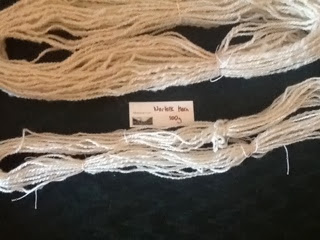
Top skein is the carded prep.  Single was 15 WPI and 2 ply 11 WPI and there are 46 yds.
Bottom skein is the combed prep, the single was 21 WPI and 2 ply 12 WPI. There is 21 yds.

With a good commercial preparation of this fiber I think this fleece would be suitable for just about any project a spinner would want to make with the yarn.


Finished merino tencel yarns


I started these yarns for the July 2012 Tour de fleece.  Both are merino tencel blends but from different sources.  The green is from Bonkers, the pink is Damselfly Fibers.  Both were 50/50 blends in 4 oz braids.

The green is 17 WPI 230 yds.  The pink is 18 WPI 225 yds.  The small skein is the two colors plied together to use up the last of what was on one bobbin of each color.  I love the combination skein, the colors look so good together, although I noticed on the photo, it can almost look brown, instead of the rose/green.  There is only 30 yds in that skein, I probably will have trouble putting it in with the other yarns in any project with so little yardage.  Right now I do not have a specific project planned although I will be looking at shawl patterns for the two yarns together.  The best satisfaction of this project was spinning the two yarns to compatable WPI over a long time of spinning, so I can use them together.


Friday, January 31, 2014

Spinning alpaca


This is the alpaca that I machine washed and dried.  After picking it open, I drum carded it on my large carder.  The pound of fiber gave me 18 batts.


I decided to spin this on my Aura because of it's large bobbins.  I will spin 9 batts on each bobbin and then ply it to a two ply.  This is the single from one batt.  It spins up quickly and there is no waste.  I didn't even have to fiddle with the spinning wheel, just sat down and spun it up.  It's a good thing the whole process will be quicker than normal, since I have another 3 lbs to wash and spin from the same fleece.


The Suri alpaca on the other hand was difficult.  I talk all about that in a short podcast on www.yarnspinnerstales in episode 102.  After lots of trial and error I finally settled on carding it with my hand cards, which worked well to spin.


I even had trouble with spinning the Suri, I had to change drive bands on my Ashford to keep from getting too much twist in the single.  I finally got things worked out so the wheel was happily spinning the carded Suri.  I love the color, it is a deep brown.  I will ply this too but not sure yet if I will do a two ply or chain ply.


Neither yarn will be lace weight and may even be too thick for socks.  I don't like 100% alpaca for sweaters, they don't hold their shape very well.  So both yarns seem to be destined to shawls or afghans.  I am sure my cat would just love sleeping on my lap with an alpaca afghan under him!

Saturday, January 11, 2014

Machine washing alpaca

I talk all about this in my podcast Yarnspinnerstales on Episode 101.  My thought was that since alpaca does not contain the scales that wool has, it will not felt as easily.  Also since it does not contain lanolin, I did not need to use soap, just hot water.

This is a lovely brown suri alpaca: 


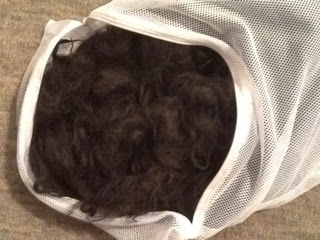
This is the suri ready to wash in a small zippered mesh laundry bag:


I put two bags of suri and one large bag of Huacaya alpaca in the washer with a full tub of warm water.  I let it go through the entire wash cycle.  Then I put those bags into the dryer, for a low heat 20 min cycle. The Huacaya alpaca came out wonderful, but the suri ended up looking like this:


My first thought was, well that didn't work and I will toss it.  Instead I started picking at the suri and found it wasn't felted or even really matted.  The length of the alpaca locks had caused it to just wind around itself.  And just like one can pick open a lock of wool, so could these be picked apart.  Once I did the bag full it looked like this:


Beautiful!  and really almost ready to spin.

This shows the Huacaya alpaca which was in very distinct locks with some crimp to them.  The color is tan with a reddish band in the middle of the locks.  Here it is ready in it's large mesh laundry bag.


I opened the dryer to find that all of this alpaca had escaped out of it's bag, not really a problem I just gathered it up.  It was clean, completely dry and not matted.  It's not ready to spin though, it will need either carding or combing.

New year, not so new socks

My knitting friends know just how long these socks took me to knit, at least two years.  They were my portable knitting project, always packed and ready to pick up at a moment's notice.  I guess there weren't enough of those moments though!  I love the color.  The yarn is Online super sock cotton which is 45% cotton 40% wool and 15% nylon.  They called the color beach.  I like that, but it also reminds me of a lovely spring bouquet of flowers.  The sock pattern is by Erica Lueder for Dreams in Fiber  and is Hermione's Everyday Socks.


Friday, May 10, 2013

Finished skein of yarn

This all started with a 4 oz braid of fiber from Natural Obsessions.  She started a fiber club using a random tarot card to inspire her dyeing.  This was the fiber from the first month of the club.  It is dyed 80/20 merino/tussah silk.  The card (which I really can't show here) was the 10 of Pentacles.  She included a color copy of the card which shows 10 gold stars.  It was those stars that I wanted to capture in the final yarn. 
 
After thinking awhile about various possible ways to do that, I finally realized I wasn't going to like anything that didn't just pop with metallic gold.  I couldn't stop thinking about that crochet cotton you see with the metal thread as one ply.  I had even crocheted snowflakes from some of that type of commercial yarn, and those really did look like gold stars.
 
So I decided I would spin all of the 4 oz of fiber as a single and try plying with the commercial yarn.
I ended up with a single of 22 WPI.  Although I forgot to take a picture of the fiber in it's braid, you can see the way to colors fell and progressed in the final yarn.
 
I went and bought three balls of the commercial yarn, in a light color with gold threads.  I tried the light color with about five yards, and washed the sample, just to see how it would look.  The yarn was fine after washing, but there was not enough gold 'pop' to the yarn.  So I went to another store and bought three balls of a gold plied with gold thread.  That was what I ended up using for this final yarn.
 
The process took a long time, because my curiousity got the better of me.  I spun another fiber into a single and went through my stash and found 12 commercial yarns to ply with that single.  It ranged from very thick to laceweight.  The results were interesting and I did a podcast about it.  I even talked about splitting up those yarns and washing them just to see if it made a difference in the next podcast.
The key point to the whole experiment is you will have the most satisfactory results if the WPI of your handspun and commercial yarn is close to the same.  As it turned out that is what happened with this skein of yarn, the hand spun was 22 WPI and the crochet cotton 23 WPI.
 
These photos show the skein all on the niddy noddy I use, both sides are all part of one skein.  Each ball of crochet cotton was 100 yards, based on what I used I should have about 425 yards.


Tuesday, April 02, 2013

Shetland locks

I bought this shetland fleece specifically to lock wash and spin very thin yarn.  I didn't think too much about the yellow on the locks, because often the yellow washes out.  Here is a picture of the raw unwashed locks, as you can see, they really are not dirty or matted.

 
This is a picture of the locks getting basted into the nylon net 'bag' I make to hold locks in place while they are being washed.  I'll make three or four of these bags, which when folded over once lay flat in my kitchen sink.  I didn't weigh anything, on an average I get about 20 locks in a bag.

 
I took this picture to show there are parts of the fleece that I do not use for lock washing, pieces no longer in lock formation, or too small to really spin as a lock once it is washed.  This will be washed as I do any fleece and probably combed with my hand held combs.

 
This picture shows the washed and dry locks.  You can see the white is much whiter, but the yellow did not go away at all.  Although disappointed with this, I am not really surprised, once I thought about it.  In my experience, fleeces that had yellow on it that did wash away had a high lanolin content.  So the yellow yoking was laying on top of that lanolin and would wash away with it.  This shetland was very low lanolin.  I hardly felt any with handling the raw fleece.  So the yolking stained the fleece itself and will not wash away.


I took a photo of the single on the drop spindle, showing some of the yellow coloring.  I do not really consider this a problem, although I won't leave the yarn white.  I will plan to dye the yarn to cover the inconsistent natural color.  The yarn I'll make with these locks is definately worth that extra step, and I would not like a white shawl anyway, my intended project for the yarn.  If one was thinking of a baby shawl, then it would be worth looking for a white shetland with no yellow to it.

I sent most of the locks to a fiber exchange partner, but kept six that I combed out with a metal tooth dog grooming comb.  These I spun on my Bosworth mini drop spindle, shown above.  It was almost too lightweight but my next size up spindle would have been too heavy..  I found my arthritic fingers did not like that flicking motion one makes on the shaft to get it moving, and I went to the roll on the thigh which, once I got past the tendency to go into 'carreen' mode, actually worked really well.  Final details on the yarn:  (weight to follow, my scales battery is dead)  23 WPI 2 ply 5 yards sample.

Saturday, March 16, 2013

Plying with commercial yarns

 This post connects with the YST podcast, episode 90.  I talk all about the why and hows of plying (and playing) with the concept of plying a hand spun single with different commercial yarns.

I have found that the blogger app for the iPad is wonderful for posting photos, but not so handy to then put text with them.  So I do the work around by posting the photos then using my desktop when I have the time to edit in the text.

How I decided to even do this spinning experiment is another blog post (coming soon, when I finish a certain yarn).  Once it had snowballed into the large, 'let's try this yarn, and this, and this' project, I knew I had to start with lots of a hand spun single.  I decided to go with a white/light color so the actual wraps of the ply twist would be highly visible.  That certainly came true, as you will see in my yards and yards of striped yarn.

I had purchased fiber from a local fiber producer here in Kentucky called Wandering Ewe Farms.  
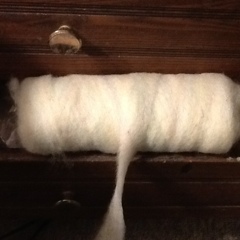
They raise Clun Forest and Border Leicester sheep and have their own mini mill to process their sheep fiber.  This first photo shows one of the bumps of fiber I bought from them.  It looks white but actually has very pale pastels in the blend.  I don't know if it is one of the specific breeds or a blend of both.  I do know that it is the first time I had ever purchased a bump of fiber packaged this way.  That is one long tube of paper that the roving is wrapped around.  The roving was even and pretty thin, I did no predrafting before I spun the single. 


I spun all 8 ounces of the bump, although this photo is about half way through the spinning.  I spun it on my Aura.  It was lovely to spin,   You can see the hints of color in the single better on the bobbin.

The fun part was then hitting my yarn stash and selecting various odds and ends of yarn to ply with the single.  I picked a total of 13 but used 12 in the final plying.  I went from as thick as I could find (the white acrylic) to lace weight thin (red on the lower left.)  Other considerations was texture (very fuzzy or bumpy) and type of fiber (hand dyed cotton, and an amazing sea silk/silk blend, that tiny ball on the lower left above the lace weight).  Here they all are, before plying.

And this, is after.  There are two skeins on the niddy noddy, the left hand side being the thicker yarns and the right hand the thinner.  If you want to play match the yarns, start with the white yarn on the upper right  and _sort of_ work clockwise.  On the niddy noddy start at the left (see the white?) and go straight across.  The end yarns on the extreme right on the niddy noddy is the red lace weight, next to last, and then the sea silk/silk, a gold color.  Maybe you can click on the photo and get a larger size to see better. 

I am not going into details about each yarn in this post, I covered all that in the podcast.  And although at first I thought I would keep each skein intact, I have since decided to cut each yarn separately, and then cut those skeins in half, and wash half.  The goal is to get a before and after washing of each plying yarn, to see how washing affects the final yarn.

Sunday, December 30, 2012

Katahdin fleece review. YST episode 86

This is not a rare breed, or even a breed of sheep commonly used for their fleece. However, a coworker raises these sheep and when she handed me a small bag of wool from her sheep, I promised her I would try spinning it. And as I often do, I shared the experience with my listeners in a podcast.

This breed is raised for meat, often by small farm owners. It's known as a hair sheep along with several other breeds because their fleece contains obvious thicker hairs all through the fleece. Another key factor is that they shed their fleece (known as rooing) which is a great benefit for small farm owners that can not get a shearer in for a small flock, or shear the sheep themselves.

Here's a link to a good website for information on the breed.

http://www.ansi.okstate.edu/breeds/sheep/katahdin/

I try to do my fleece reviews in a similar format, by using washed fiber, carding some and combing some. When I did this for this fleece, it became very interesting to find how it removed many of the hairs, in the combed fiber, but incorporated those hairs into the carded batt. When I spun my sample singles, the combed was mostly smooth, and the carded spun much thicker and showed lots of spikes of the hair.

I decided to leave the singles on the bobbins awhile (OK, so I did have to get the holidays over)and then knit something to show off the different textures. I knit straight from the bobbins, with very little problem with twist. The small sample skeins taken at the end of the singles after knitting do twist up, so there's still excess twist there. It just did not interfere with the knitting, since the single sat on the bobbin awhile.

Now I am quite use to handling wool, and to my fingers this fleece did not feel scratchy, unlike what you would think looking at it. Of course I did not knit a wearable item, instead I knit a small coaster.

In the photos you can see the singles on the two bobbins, one combed and one carded. The second photo shows the coaster with sample skeins. The center of the coaster is knit with the combed, smooth single, and the edging is knit with the thicker carded single. I used the same size needles, the edging looks thicker, because the single was thicker.

With all the wonderful fleeces in a spinner's world, I am sure there would not bea reason to do a whole fleece of this breed. However it was very interesting to work up this sample, for my sheep breed file.


Saturday, December 29, 2012

A blanket for my grandson

It was a long time in the making, and then several months before I got this posted. But I did make a knit blanket to welcome my first grandson to the fact his grandma knits for those she loves.

I wanted something colorful, and had picked a color work pattern way back a year ago in Dec. I bought four yarn colors as suggested by the pattern. My choice was a variegated in pastels (but not the traditional pinks and blues) and three colors that matched the variegated. I cast on, knit the edging and started the pattern. I quickly realized this pattern really was not good for a baby. It was a blanket, but the pattern seemed to ignore the fact there was a wrong side, and that side was ugly with stranding. I was about three inches into it, when I decided that it was not what I had in mind at all.

It sat for two months while I looked for the elusive pattern I had knit years ago for a coworker's baby. It was slip stitch and you never carry more than two yarns. I finally found it, a copied sheet. I have no idea of the source of the pattern. It looks striped because it is done in two row sections then there is a color change. I started the edge with the variegated, then went in the same color sequence every two rows with two rows of the variegated between color changes. The variegated yarn was carried up the side of the entire blanket. The other colors were cut and the ends woven in as I went, a true disciplined act on my part.

The slip stitch in the pattern creates the honeycomb look as the slipped stitch is carried up the two rows. The variegated rows were plain knit.

Ethan arrived March 1st, six weeks early. The new pattern blanket had just barely been started. I finished it in Oct, and he loves sleeping with it.